Ghana, May 2025
An interview with the Director of Crop Services (DCS) of the Ministry of Food and Agriculture (MOFA)
Dr Solomon Ansah is the current Director of Crop Services of the Ministry of Food and Agriculture and a Focal Point of the Ghana National Rice Development Strategy (NRDS). Before becoming the Focal Point the NRDS, Dr Solomon was a member of the task force team for several years. He was part of the team that drafted the strategy.
In this interview conducted by the CARD Senior Regional Advisor, Dr Solomon gave an overview of the rice sector of Ghana, the challenges that are currently hindering the rapid development of the sector and what can be done to accelerate the development towards attaining the goal of the NRDS which is self-sufficiency in rice production by 2028.
The interview was conducted in Koforidua, Eastern Region, Ghana, during the formulation of the NRDS concept notes.
An overview of the Ghana rice
In Ghana, rice is a significant staple food, cultivated as both a food and cash crop, with increasing consumption driven by population growth and urbanization and change in consumer habits. While local rice production is important, Ghana’s reliance on imported rice remains high due to a gap between domestic supply and growing demand. The rice value chain in Ghana involves various actors, from subsistence farmers to commercial producers, with a mix of traditional and modern technologies.
History of rice cultivation in the country and when it first became a staple crop
Rice production in Ghana has a history dating back to the 17th and 18th centuries, when it was already a significant commercial food crop in the region. However, it was not until the 1960s that rice became a major crop in Ghana, with a significant portion of the country’s rice supply coming from the Northern region. Ghanaians prefer crops that can be easily cooked and stored for a long time so that they can fall on such crops for household consumption when such crops are out of season.
Comparison of rice to other staple crops in terms of importance
Rice is ranked as the second staple crop after maize. Rice is consumed in almost every home in Ghana so it is very, very important.
The main players involved in the sector
The main players involved in the rice sector can be found in both the seed and the commodity value chains. This include researchers, seed producers, paddy producers (farmers), millers, wholesalers, retailers, consumers and marketers.
Current level of national rice production in relation to domestic demand, is the country self-sufficient or dependent on imports?
Current level of rice production is about 750,000 MT while the level of consumption is 1.5 million MT (milled). We are 51% self-sufficient in rice production which means 49% of rice are brought in as imports.
Major challenges faced by rice farmers in the country
- High Cost of Land Development and inadequate machinery and equipment for production: The cost of land development for rice production ranges from GH¢ 25,000.00 to GH¢ 50,000.00 per hectare (MoFA, 2023) depending on the ecology which most farmers cannot afford. This accounts for the limited area under production.
- Inadequate irrigation and Poor water management: The irrigation ecology which gives the highest yield (average 5.5 MT/ha) accounts for less than 10% (about 38,000 ha) of current area cultivated each year. Limited maintenance of the existing irrigation infrastructure has also led to the deterioration of the facilities, which in turn, affects productivity.
- Poor quality of processing and storage facilities: Although there is sufficient processing capacity for rice, the quality of milled rice produced is generally low as a result of lack of grading, poor handling, presentation, and packaging.
- Other challenges include low yields, limited market access, and infrastructure constraints for many farmers.
Main constraints faced by researchers
The first constraint faced by researchers is about inadequate funds to maintain the released rice varieties in order to churn out quality early generation seeds at all times. Funding for carrying out research is limited. There is the need for dedicated funds to carry out rice research.
Major challenges in replacing imported rice with local rice
In fact, the first challenge is that imported rice is relatively cheaper than domestic rice, the cost of production as far as imported rice is concerned is very low compared to the local rice cost of production. Moreover, the quality of imported rice is relatively higher than that of the domestic rice. it is a big challenge so we need to really work on the quality. Some of the local mills lack graders, destoners, color sorters, silos etc. There is the need to maintain the relative humidity and temperature of the paddy in order to obtain high milling recovery. There are limited efforts to promote domestic rice. This narrative must change. The Government must join hands with all the rice stakeholders to carry out intensive promotion nationwide on Ghana rice.
Some initiatives to promote the consumption of local rice over imported rice
During national farmers day, rice stakeholders are allowed to exhibit their products to the entire general public. Some specific projects being implemented in Ghana e.g. Ghana Rice Production Improvement Project (GRIP) do target their activities to promote Ghana rice. The Ghana Rice Interprofessional Body (GRIB) leverages on their annual rice festival to promote Ghana rice
Significant opportunities for growth or improvement in the rice industry
Opportunities are there because we have a number of rice researchers who carry out rice research along the value chain and this includes breeding, socio-economic research, pests and diseases on rice, rice agronomy etc. Ghana has potential number of inland valleys that can be developed to increase area under rice production. Presence of human resource capital along the rice value chain to increase production, productivity and profitability of Ghana rice.
Some major benefits of the country joining the CARD initiative
CARD has supported Ghana immensely in developing our NRDS 1 and NRDS 2. CARD has a number of Consultants (one of them is with me right here!) who support the rice task force in Ghana to develop the NRDS, sub-sector intervention element matrix (SIEM) to identify the gaps as far as the NRDS thematic areas are concerned. The CARD Coordinator and the staff always join hands with us to guide us to develop concept notes that subsequently will be introduced to development partners for their buy-in and possible funding. The CARD Secretariat has supported Ghana to develop M&E baseline survey on 12 standard indicators and others which could be used to track the progress in implementing the NRDS. CARD organizes bi-yearly annual general meeting where all the CARD member countries and steering committee members meet to deliberate issues that will promote rice production, productivity and profitability.
Some solutions the NRDS has put in place to boost rice production and improve the competitiveness of local rice
The NRDS document in Ghana is quite robust. It clearly states the strategic interventions in seven (7) thematic areas for the growth of the rice industry in Ghana. The seven thematic areas of the NRDS include: Seed System; Fertilizer marketing; Distribution and usage; Post-harvest handling and marketing; Irrigation and Water Control Investment; Equipment access and maintenance; Research, Technology Development and Transfer as well as Community Mobilization. We have identified some gaps in the seven (7) thematic areas which have led to the development of concept notes. The concept will subsequently be blown into fully fledged proposals for implementation.
Expectations to CARD
It is our expectation that CARD continues to interact with us in-country and supports us in implementing the monitoring system of M&E. CARD should continue to guide us on how to increase rice production in Ghana.
Steps being taken to ensure sustainable rice production in the country and sub- regional level towards increasing rice production in the short, medium and long terms
Developing and bulking of the rice varieties as well as farmers having access to the rice varieties at all times (both short and long term) is key in sustaining productivity in-country and at the sub-regional level. Also, strengthening the Farmer-Based Organizations (FBOs and Cooperatives), in the short and long term, will expose them to obtaining production inputs on credit, bargaining power in terms of marketing, access to quality capacity. In the short term, there is a need to upgrade existing mills and procure state-of-the-art mills to increase milling efficiency.
The rice value chain is dynamic. For the long term, there is a need for research into climate resilient varieties, socio-economic research, pests and diseases etc., to proffer solutions to practitioners and industry.
Due to the huge investment in land development, in the short to long term, there is a need for African Governments to develop large tracts of land and also develop frameworks for the use of such lands for farmers to benefit.
A greater proportion of farmers have limited access to agricultural services. For the short to long term, it would be prudent for the Government to partner with the private sector to strengthen existing farmer services centres and build new ones at strategic locations where the majority of farmers would have access to subsidized mechanization services, agricultural inputs, extension services etc.
Position regarding Inclusive farming
Inclusive farming in Ghana ensures that the benefits of farming in Ghana are shared by all, meaning that every smallholder farmer, woman, man, youth, or even people with disabilities, should have access to what we are doing as far as it involves rice. Inclusive farming involves creating access to resources markets, and opportunities and empowering individuals in the communities to thrive.
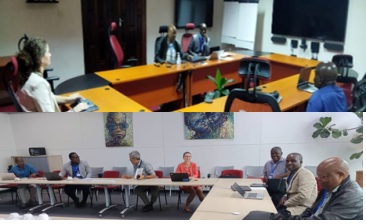
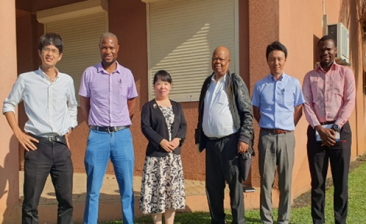
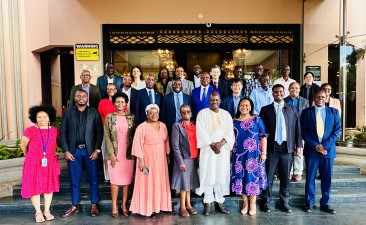
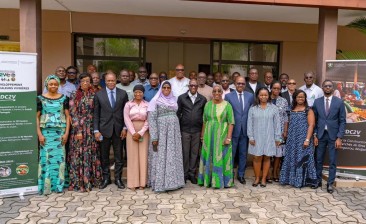
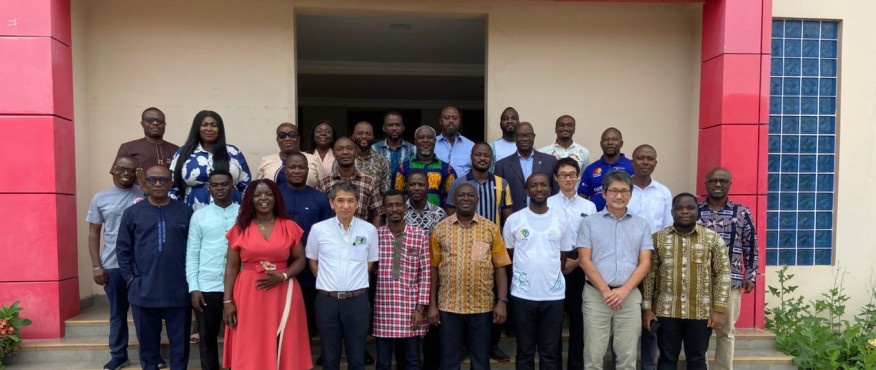
CARD with Ghana Taskforce team workshop in May 2025
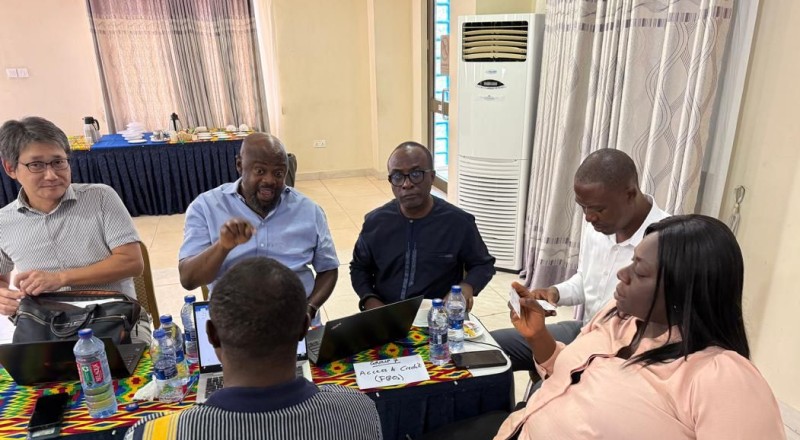
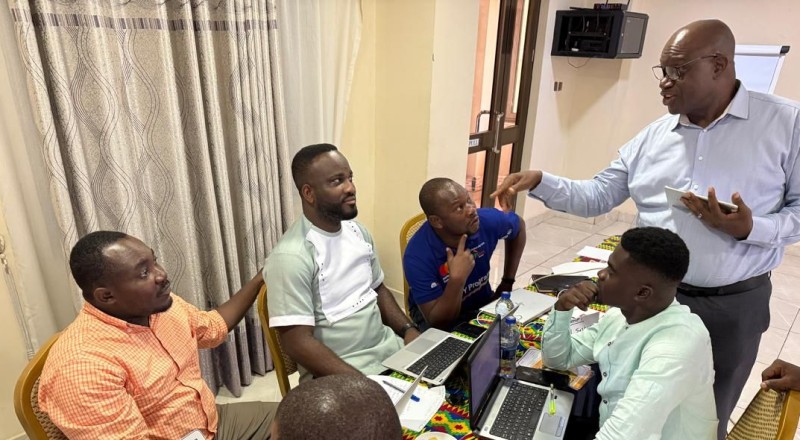
Dr Solomon Ansah, the Director of Crop Services of the Ministry of Food and Agriculture