Private sector commitment to sustainable rice-sector financing
Côte d’Ivoire’s frontline model of structured contract farming (rice aggregation)
The rice sector is a key pillar of food security and economic development in Africa. However, it still faces a sustainable investment gap, limiting its growth and resilience to climate and socio-economic challenges. The engagement of the private sector is crucial to mobilize the necessary financial resources, foster innovation, and promote sustainable agricultural practices. Through public-private partnerships, it can facilitate access to appropriate financing, support research into resistant varieties, and strengthen the value chain from production to marketing. Thus, increased private sector involvement helps stimulate economic growth, increase productivity, and ensure a resilient and inclusive rice sector. Its role is essential to ensure sustainable financing and food security in Africa.
Côte d’Ivoire’s case in structured contract farming (rice aggregation)
Rice, a pillar of food security in Côte d’Ivoire, is much more than just food. It embodies the hope of millions of families, the promise of sustainable economic development. However, despite this importance, the annual production of about 1.4 million tons covers only about 55% of national consumption needs. This is due to the existence of many challenges, including limited access to finance for local actors, who are often left behind.
To address these challenges and drawing upon the experiences observed in various Agricultural industrial sectors, the National Rice Development 2024-2030 (NRDS) proposes a bold solution: rice aggregation or structured contract farming. An innovative model that aims to sustain the financing among the rice value chain through the connection of producers, economic and financial actors in order to give a new impetus to the sector, so that it finally becomes a lever for inclusive growth. In concrete terms, this system is based on a contractual approach between producers and/or service providers (aggregate), and a key player: the aggregator, often a private actor (small, medium and/or big processors), supervised by a regulator, the Agency for the Development of Rice Cultivation (ADERIZ).
The aggregator, the pivot of the rice value chain
The aggregator occupies a strategic position in the rice value chain. In direct contact with upstream producers and downstream distributors, he connects the players in the sector, coordinates the value chain, optimizes all flows and guarantees a supply of quality rice to ensure the continuity and performance of the value chain.
The aggregator acts as a structuring intermediary by organizing access to inputs, production, collection, processing and marketing of rice. This central role is exercised within a secure contractual framework and under the regulation of ADERIZ, in particular thanks to the digitalization of the sector, which improves the traceability and reliability of economic data.
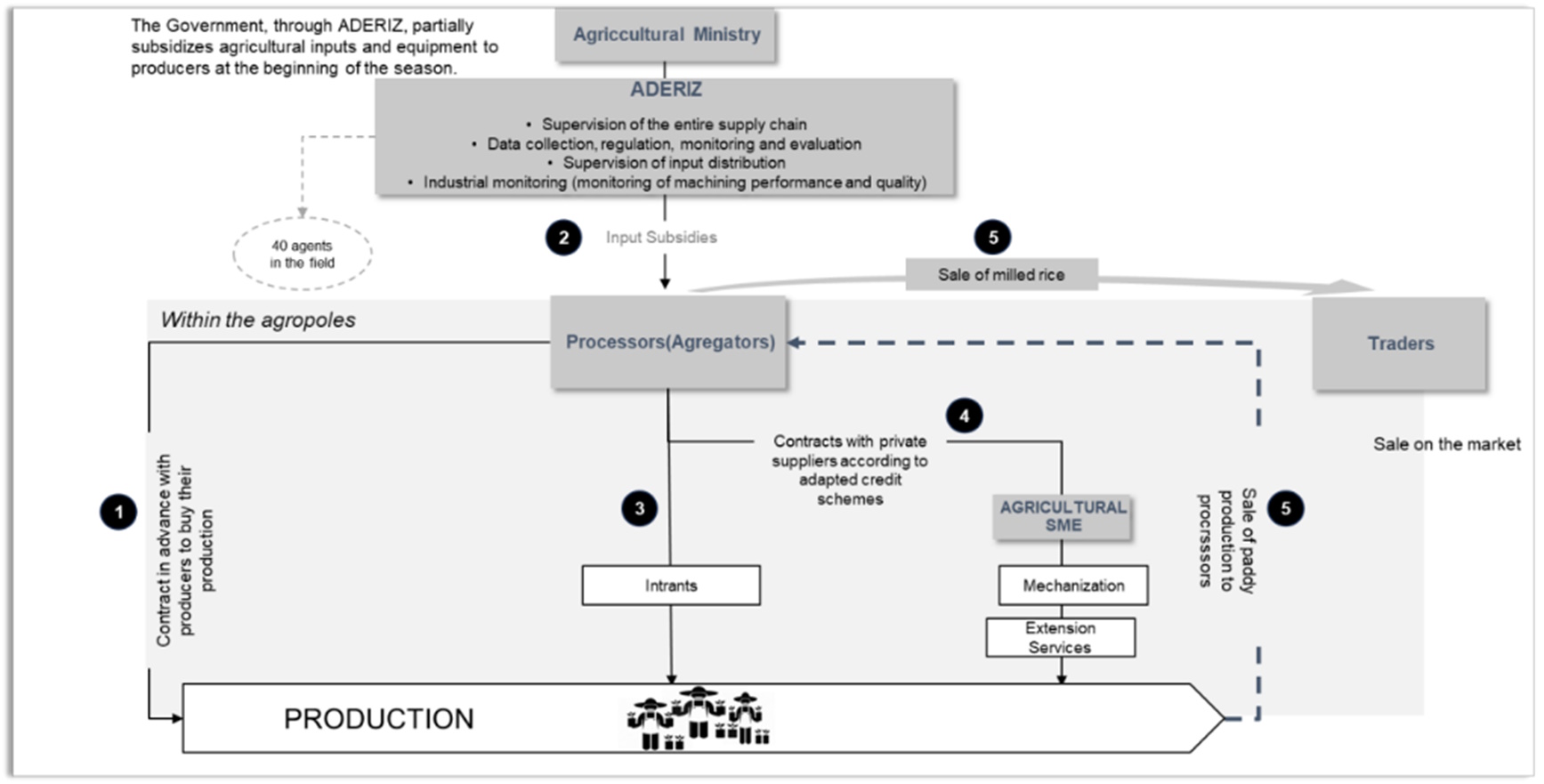
Figure 1: Structured Finance Model
Source: ADERIZ, 2025
Securing paddy and milled rice at the heart of the model
In the structured finance model, a security mechanism governs the collection, storage, processing and marketing of paddy and milled rice. Based on traceability, inventory control and risk management, it allows paddy and milled rice to serve as financial guarantees with the partner bank. A dedicated operator ensures the implementation of the said system.
Digitalization as a catalyst: the “Riz-Digit” platform
To support the model, ADERIZ has set up the “Riz-Digit” digital platform, which allows precise monitoring of production, marketing and financing flows between the various players in the sector. By strengthening transparency and traceability, it is a key tool for securing transactions and facilitating the mobilization of appropriate financing in order to restore confidence between all players in the rice sector.
Integrated functions for financing and performance
The aggregation model is based on a set of complementary functions, performed in an integrated manner by the aggregator:
- Access to finance: by consolidating financial needs and flows, the aggregator facilitates the mobilization of credits and subsidies, reduces risks and improves financing conditions for affiliated producers
- Access to inputs and mechanization: it makes available, in a timely and cost-effective manner, the agricultural inputs and mechanized services needed to improve yields.
- Technical capacity building: through training, advisory support and the introduction of adapted solutions, the aggregator improves cultivation practices, paddy quality and the sustainability of production systems
- Logistics and supply management: he centralizes paddy collection, optimizes storage and transport, reduces post-harvest losses and secures the supply of the processing unit.
- Market access: through contracts with processors and distribution networks, the aggregator guarantees stable outlets for producers and an offer in line with market requirements
Shared benefits for all stakeholders
Thanks to this model, producers benefit from better access to inputs, more remunerative prices and a collective organization that generates economies of scale. The aggregator, for its part, secures its supply of quality paddy, facilitating industrial planning and risk management. Distributors have access to a rice supply in line with market expectations, thus contributing to the stabilization of prices and the strengthening of national food security.
A model in the test phase
The rice aggregation model is currently being rolled out on a pilot basis, with financial support from the World Bank. The objective of the pilot is to be part of a gradual process of structuring supply chains, in particular through the establishment of a seed fund to test and adjust the model. The model chosen in the project is schematized below according to the different flows.
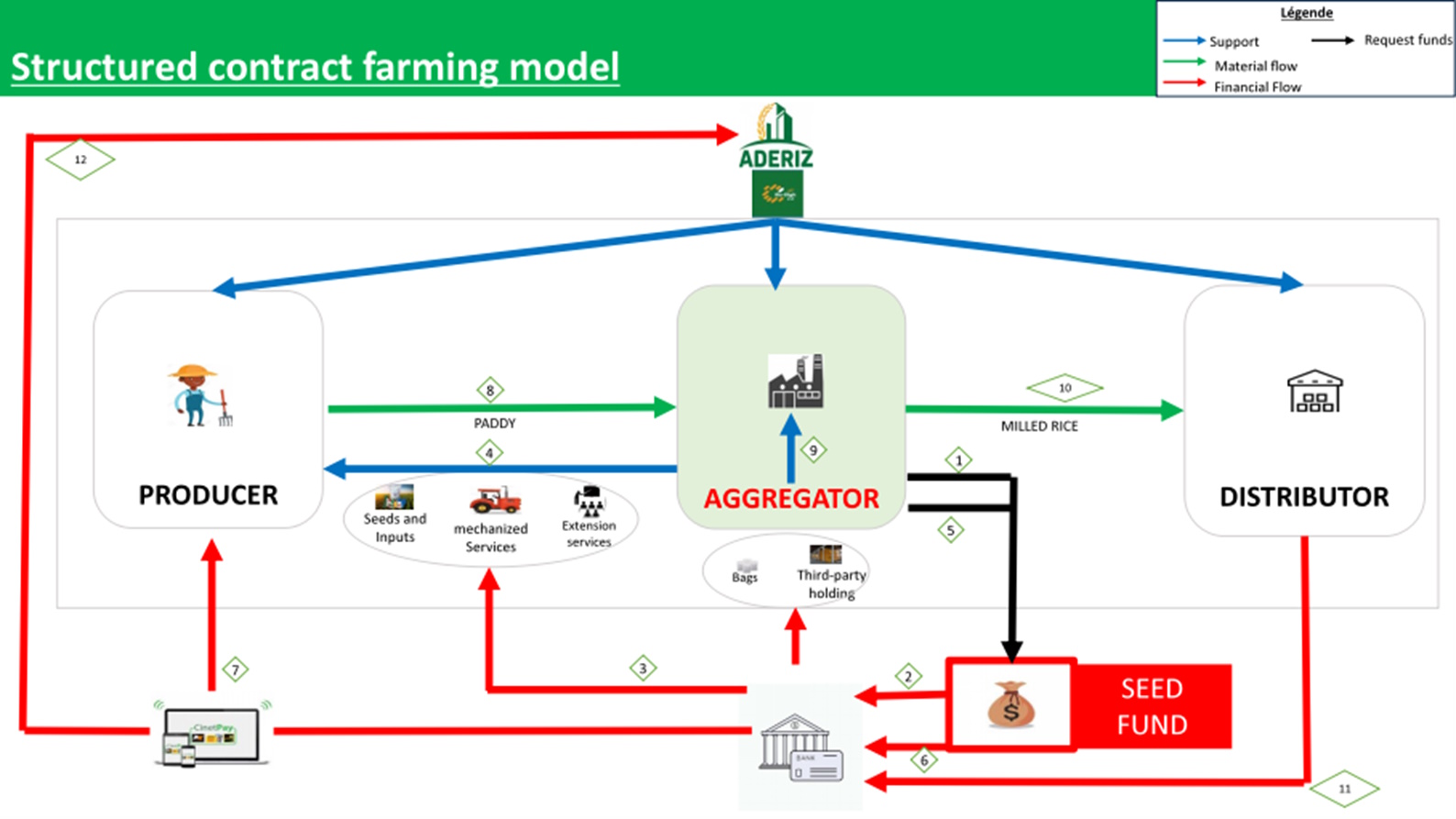
Figure 2: Financing mechanism by the aggregator provided by ADERIZ
In the model, a seed fund is embedded within a financial structure designed to support the financing of rice production, processing, and marketing activities. This fund aims to facilitate the pre-financing of the entire value chain and to enable the involvement of financial institutions in the rice value chain.
Following the mobilization of financial resources and the registration of the entire contractual mechanism within the rice-DIGIT platform (identification and contracting of stakeholders, georeferencing of production sites, and documentation of production objectives), aggregators request support from financial institutions to assist producers. This assistance primarily focuses on the procurement of agricultural inputs, access to mechanization services, and the enhancement of producers’ technical capacities.
Benefiting from this support, producers undertake rice cultivation and sell their paddy to the aggregator in accordance with contractual obligations. Payments for the paddy are made in cash, sourced from the funds mobilized by the aggregator from the financial institution. The accumulated paddy stocks are then placed under third-party custody to secure transactions and mitigate financial risks.
Subsequently, the collected paddy is processed by the aggregator into white rice, which is then marketed to distributors. Revenue generated from sales enables the aggregator to reimburse the financial institution, replenish the seed fund, and sustain the operational mechanism.
This system, coordinated and supervised by ADERIZ, facilitates the structuring of raw materials, financial, and informational flows, ensures secure relationships among stakeholders, and promotes the sustainability of financing cycles within the rice sector.
The results of this experimental phase will be decisive in assessing the relevance of the model and considering its scaling-up. In the long term, rice aggregation could become a major lever for the sustainable transformation of the rice sector in Côte d’Ivoire.
In view of the structured financing model that ADERIZ is seeking to set up, it appears that the effective involvement of the private sector in the rice sector should not be perceived as a question of economy but as a challenge of sovereignty, employment and stability for the country. This is how the rice sector could finally rise as a symbol of resilience and self-reliance, guided by private sector engagement, political will, and technological innovation. The future of Ivorian rice cultivation is at stake through the implementation of this scheme. It needs everyone: actors, decision-makers, partners. Together, they can build a strong, equitable sector, capable of feeding the nation and making the Ivorian economy shine on the African scene.