Tanzania, August 2025
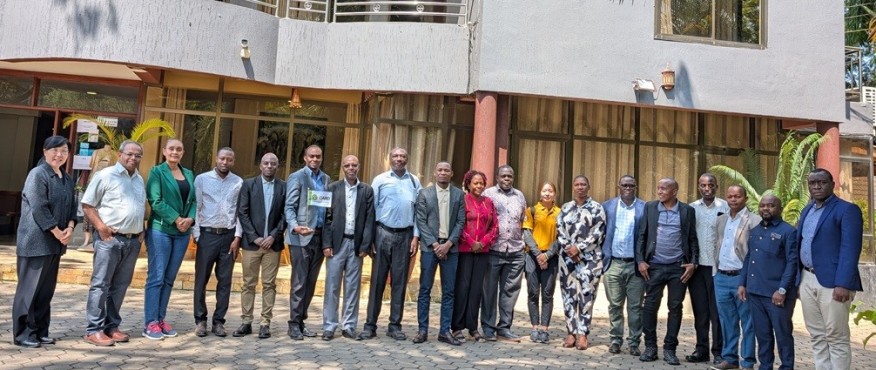
Workshop on Monitoring & Evaluation of NRDS-2 in Tanzania on 20 – 22 August 2025
Tanzania has recently become a net exporter of rice in the region. Against an estimated domestic consumption requirement of 2.06 million tons, the country produced 2.13 million tons of milled rice in 2023. Average volume of annual rice exports from Tanzania since 2020 stands at 386,438 tons. Most (98.74%) of the surplus is exported to neighboring countries in the EAC region under zero tariff rate. With EAC markets running a deficit of 2 million tons of milled rice, Tanzania’s scopes for further expansion of its domestic rice production holds several advantages.
National Rice Development Strategy (NRDS-2; 2019-2030) hence aims to become a regional market leader by targeting a surplus production of 3.3 million tons of milled rice by 2030. Achieving this goal requires a coordinated improvement in efficiency of both the domestic and regional supply chains of Tanzania rice. The NRDS taskforce members have established a monitoring and evaluation (M&E) framework that allows track progress made under the implementation of the NRDS-2. The M&E framework involves 4 overall indicators, 2 indicators each under Resilience (R), Industrialization (I), Competitiveness (C) and Empowerment (E) and 2 Tanzania-specific indicators (fertilizer use and postharvest losses). The NRDS TF is expected to share the results from the M&E process with rice value chain stakeholders through Annual Rice Sector Rice Review Meeting (ARSRM). The NRDS TF requested the CARD Secretariat to facilitate discussions on the M&E exercise for 2025-26 by organizing a workshop. This report briefly summarizes the major outputs from the workshop.
Outputs and Way Forward
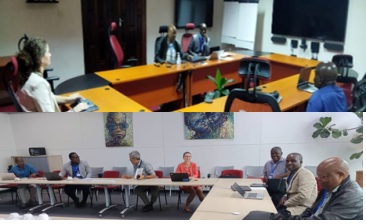
The workshop was organized at Hotel Panama in Moshi during 20-22 August 2025. About 16 participants representing NRDS TF attended the meeting. The expected outputs from the workshop include (1) revision of targets set for 2030 under the NRDS-2 and M&E, (2) review the definitions and scopes of M&E indicators based on lessons learnt from last years’ experience, (3) consensus on responsibilities and timeline for the next cycle of data collection, (4) updating of gaps in funding for the implementation of the NRDS-2 and exploring prospects of resource mobilization, (5) formulation of new concept notes for fund mobilization, and (6) planning for the next ARSRM (2025-26).
Revision of targets under NRDS-2 and M&E indicators and data collection
Targets NRDS-2 were set by the TF members in 2018-2019 during the formulation stages of the NRDS-2 through brainstorming. It was decided that domestic milled rice production could be increased by 4.4-fold to 8.8 million tons from 2.2 million tons observed in 2018. During the first ARSRM, the Ministry officials felt that this target may be less realistic and advised the NRDS TF members to revise. During this workshop, the NRDS TF members looked through the targets set under Agenda 2030 (referred to as 10/30) for various food crops. In alignment with 10/30, the TF members agreed to reset the paddy production target under NRDS-2 to 10,235,560 tons (equivalent to 6.85 million tons of milled rice, about 3-fold increase from the baseline) by 2030. Accordingly, the targets for overall indicators such as area under rice cultivation, yield, self-sufficiency rate, and other relevant R.I.C.E indicators under the M&E were revised.
Confirmation of M&E indicators and data collection
The NRDS TF members began by reviewing the challenges faced during the 2024–2025 M&E data collection. Building on lessons learned, they held in-depth discussions on each NRDS indicator, refining definitions, secondary data sources, and data collection methods. They also unanimously agreed on assigning responsibilities for the upcoming 2025–2026 M&E exercise.
Gaps in funding and Resource Mobilization
Achieving the NRDS-2 goals require several interventions across the rice value chain. During July 2024, the NRDS TF analyzed the gaps using Subsector Intervention Element Matrix (SIEM). Several new interventions have however taken place in Tanzania since July-2024. To update the gaps in the required interventions (proposed in the NRDS-2), the NRDS TF members revisited the SIEM-Gaps and reviewed the on-going interventions and the current intensity of gaps in funding.
The NRDS TF members discussed about the possible funding avenues for the interventions that are required to address the gaps. The NRDS TF affirmed that all fund mobilization activities are carried out under the auspices of Permanent Secretary (PS) at the Ministry of Agriculture (MoA). The TF members further informed that individual NRDS TF members are not empowered to directly approach any of the funding agencies. Nevertheless, the members identified three possible pathways, viz., global funds that are directly accessible by various institutions in the country, development partners in the country and regional sources.
It was agreed that the NRDS Focal point shall inform the PS of MoA on the gaps and the proposed interventions (Concept Notes) under the NRDS-2. If partnership and/or funding from private sector is required from the private sector, the Chairperson of the Rice Council of Tanzania (RCT) who is also a member of the NRDS TF shall inform the PS of MoA.
Formulation of new Concept Notes and update on existing concept notes
During the 1st ARSRM, the TF members submitted 10 concept notes (CNs) that they prepared for promoting implementation of the NRDS-2 to the stakeholders for their consideration. The stakeholders pointed out that some of the concepts submitted by the TF were being addressed through projects and programs on the ground. The stakeholders therefore advised the TF members to review the CNs and exclude the activities that are already being covered.
In addition, the stakeholders also advised the TF members to include new CNs through which emerging issues viz., (i) accessibility to spare parts for machineries, (ii) water usage in rainfed and irrigated rice ecosystems, (iii) accessibility to seeds of improved varieties, and (iv) sustainability of rice farming.
During this workshop, the TF members hence reviewed the CNs that were submitted at the last ARSRM and formulated 4 new CNs on the areas suggested by the stakeholders. Upon careful revision of the existing CNs in the light of current interventions, the TF members decided to remove a specific objective on varietal development from CN#1 and keep CNs 8, 9 and 10
For developing new CNs, the TF members divided into 2 groups and established the required contents for a 1-page CARD format. Group leaders who facilitated the discussions in the 2 groups shared the CNs through a plenary session for peer-review. The inputs and corrections suggested from this plenary session were then captured in the 4 newly formulated CNs.
Way Forward
The NRDS TF members have decided to collate the M&E data for 2025-26 by 30th September and validate the data and prepare the deliverables for the 2nd ARSRM in consultation with CARD Secretariat in October. Furthermore, they have planned to approach development partners such as World Bank, African Development Bank and EU for sponsoring the organization of the 2nd ARSRM, which they agreed to hold by early February 2026.