Sustainable rice production and future food security in Africa
The necessity of joint efforts: Toward sustainable rice production and future food security in Africa
Food security is a longstanding challenge facing Africa. Food is indispensable for all, and food security is one of seven main categories of human security (UNDP 1994). Sustainable Development Goals (SDGs) Goal2 aims to target “By 2030, end hunger and ensure access by all people, in particular the poor and people in vulnerable situations, including infants, to safe, nutritious and sufficient food all year round.”
FAO, IFAD, UNICEF, WFP, and WHO (2025) indicated that while 8.2% (2024) of the population still faces hunger in the world, this proportion is declining from 8.5% (2023) and 8.7% (2022). However, Africa is the only region in the world where the proportion of people suffering from hunger is increasing. This proportion stands at 20.2% (2024), approximately 2.5 times the global average, and has increased significantly from 15.9% (2015), when the SDGs began. In Africa, food production and imports are failing to keep pace with the growing demand for food driven by population growth and economic development, leading to a gradual deterioration in food security.
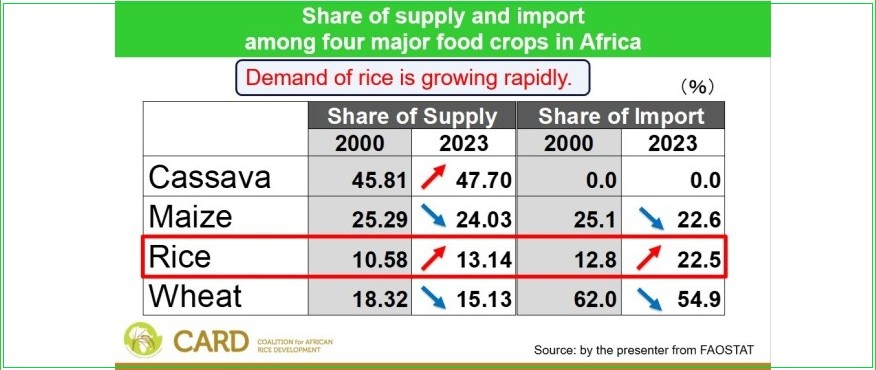
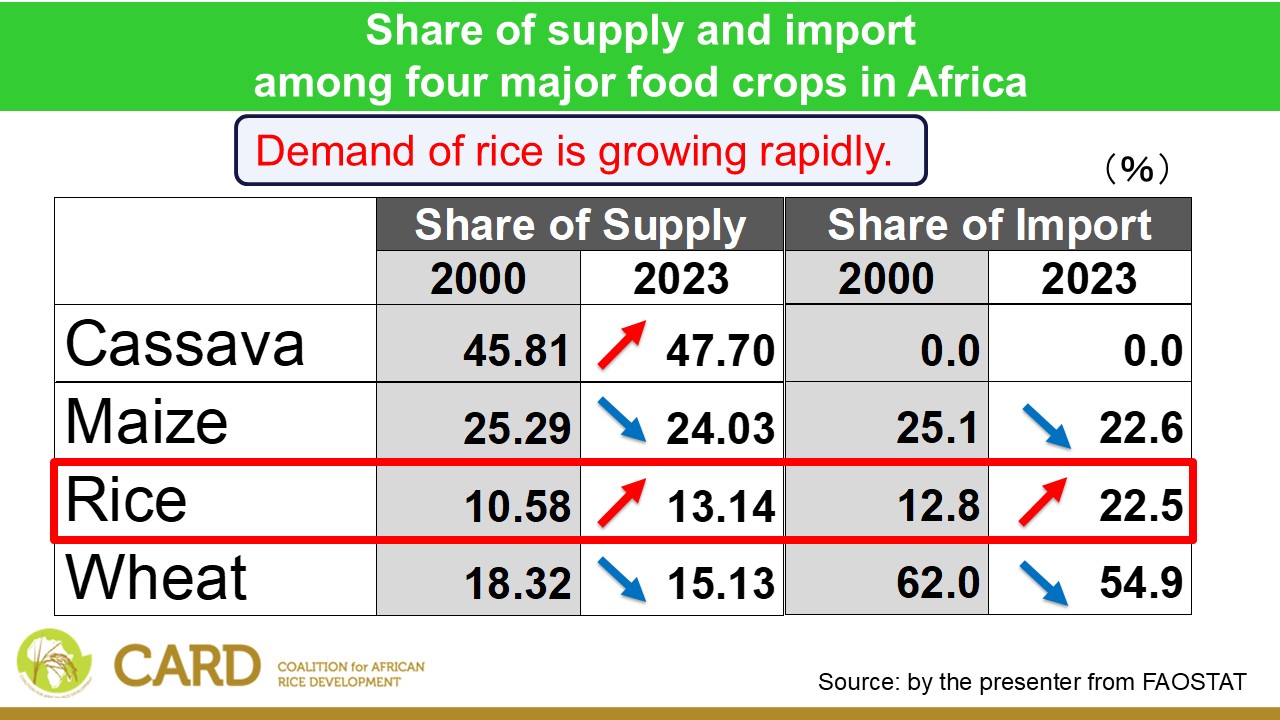
Particularly, rice demand is growing sharply. The table below shows changes in the share of supply and imports among Africa’s four major food crops (cassava, maize, rice and wheat) between 2000 and 2023. Rice is the only food crop where both supply and import shares have increased. Rice imports have expanded rapidly, with rice’s share of total imports surging from 12.8% (2000) to 22.5% (2023).
Rice demand in Africa has grown at a rapid pace of 6% per year on average over the past decade (Arouna et al. 2021). Rice will soon surpass maize to become Africa’s second-largest imported food crop after wheat. According to AfricaRice, Africa spends a substantial more than US$6 billion annually on rice imports (AfricaRice HP). Rice self-sufficiency rates in Sub-Saharan Africa (SSA) have been declining yearly, reaching only 58.3% in 2024 (FAO STAT).
The Coalition for African Rice Development (CARD) has been implemented as a continental initiative since 2008, aiming to increase rice production in SSA. CARD Phase 1 (from 2008 to 2018) achieved its goal of doubling rice production in SSA (28 million tons in 2018). Given the significant growth in rice demand in SSA, the CARD transitioned to Phase 2 in 2019, aiming to further double rice production over 12 years (56million tons in 2030). However, while rice production in SSA is steadily increasing (approx. 38 million tons in 2024), achieving the 2030 target at the current pace is extremely difficult.
The primary cause is low productivity. Rice production area has been expanding rapidly in Africa over the past 20 years. However, comparing rice productivity trends in Asia and Africa shows that while there was little difference in productivity in the early 1960s, the gap gradually widened. Currently, Africa’s rice productivity stands at only 2.31 t/ha (2023), less than half that of Asia (4.99 t/ha, 2023).
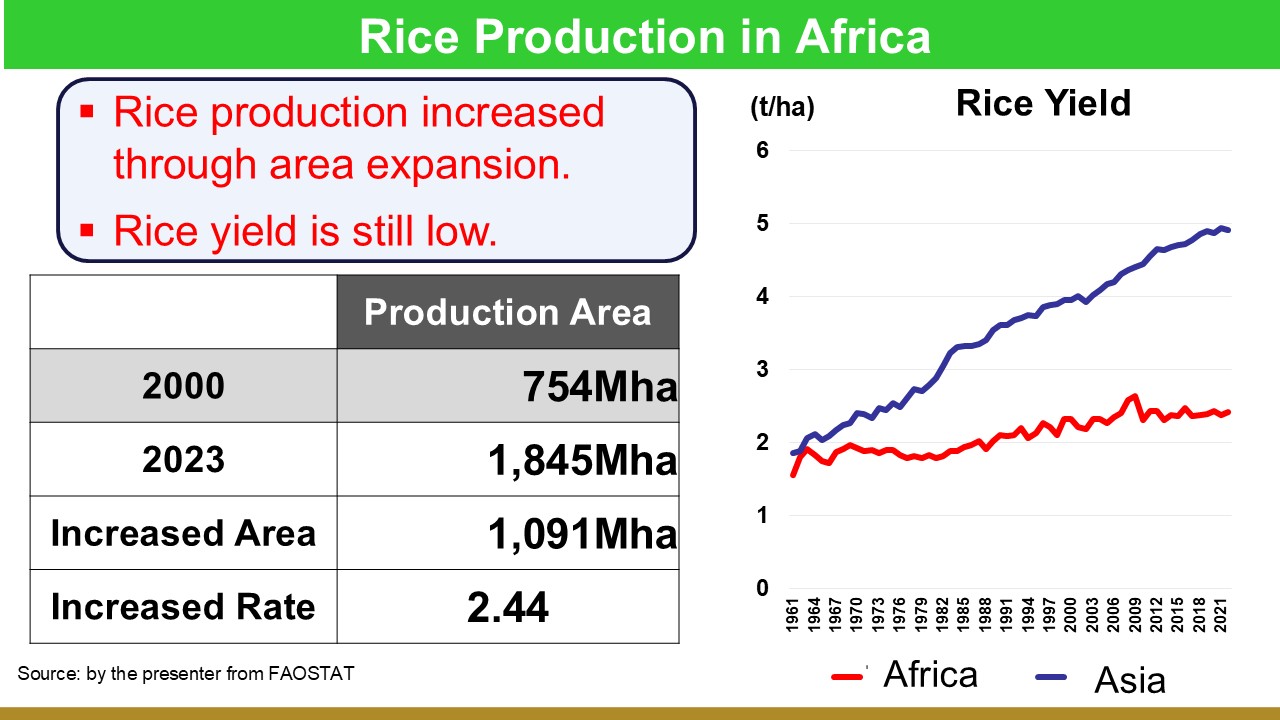
The main reason for this low productivity is insufficient resource mobilization. In Asia, from 1967 to 1982 which was the main period of Asian Green Revolution, rice production increased by an average of 2.54% annually (Hazell 2009). This growth was driven by substantial investment by the national governments. On average, twelve Asian countries’ governments allocated 15.4% of their national budgets to the agricultural sector in 1972 and 12.4% in 1980 (Rosegrant and Hazell 2000, Hazell 2009). Substantial public investment by national governments underpinned the advancement of the Green Revolution.
However, the current share of national budgets allocated to the agricultural sector in African countries averages only 2.55% in 2020 (FAOSTAT). In Africa, only about one-fifth to one-sixth of the national budget allocated during Asia’s Green Revolution is allocated. Today’s African agricultural sector differs significantly from that during Asia’s Green Revolution, requiring actions to broader development issues such as advancing Agrifood Systems which cover not only nourishing all people (food security and nutrition), but also boosting nature-based solutions (environment), advancing equitable livelihoods (women, youth and vulnerable groups) and building resilience vulnerabilities, shocks and stresses (climate change). Beyond the minimal national budget allocated to agriculture, food security cannot be prioritized at the same level as during Asia’s Green Revolution. Consequently, an extremely small portion of national budgets is allocated to food production.
Beltran-Peña et al (2020) evaluated that, under any scenario, Africa will be unable to achieve food self-sufficiency by 2100, with the situation worsening compared to the present. Kampala CAADP Declaration (2026-2035), which was adopted at African Union Extraordinary Summit in January 2025, raises to intensify sustainable food production, agro-industrialization and trade by increasing agricultural and food production by 45% by 2035 through sustainable agriculture. Now is the time for the AU, Africa’s leading organizations, and African national leaders to reaffirm that, although the African agricultural sector faces a number of development issues, food is essential for human security, necessary actions must be taken such as adopting a long-term perspective on Africa’s food security, and spearheading initiatives prioritizing food security, including rice development under their strong political leadership.
*The detailed information can be accessible through the link below.
Shinjiro Amameishi: AGRA Summary paper “Food security in Africa and importance of rice production: promotion of Coalition for African Rice Development (CARD) and future rice development in Sub-Saharan Africa” Food Security in Africa and Importance of Rice Production: Promotion of Coalition for African Rice Development (CARD) and Future Rice Development in Sub-Saharan Africa
Shinjiro Amameishi: JICA Research Institute Knowledge Report “Food Security and Rice Production Potential in Africa: The Future of the Coalition for African Rice Development (CARD)” No.14 Food Security and Rice Production Potential in Africa: The Future of the Coalition for African Rice Development (CARD) – JICA Ogata Research Institute
References
Arouna, Aminou., Irene Akoko Fatognon, Kazuki Saito and Koichi Futakuchi. 2021. “Moving toward rice self-sufficiency in sub-Saharan Africa by 2030: Lessons learned from 10 years of the Coalition for African Rice Development” World Development Perspectives (21) 100291
Beltran-Peña., Areidy, Lorenzo Rosa and Paolo D’Odorico. 2020. “Global food self-sufficiency in the 21st century under sustainable intensification of agriculture” Environmental Research Letters 15 (2020) 095004
Food and Agriculture Organization (FAO), International Fund for Agricultural Development (IFAD), United Nations Children’s Fund (UNICEF), World Food Programme (WFP) and World Health Organization (WHO). 2025. The State of Food Security and Nutrition in the World 2025: Addressing High Food Price Inflation for Food Security and Nutrition
Hazell, Peter B.R. 2009. “The Asian Green Revolution” IFPRI Discussion Paper 00911, 2020 Vision Initiative
Rosegrant, M.W., and P.B.R. Hazell. 2000. “Transforming the rural Asia economy: The unfinished revolution” Hong Kong: Oxford University Press.
United Nations Development Programmes (UNDP). 1994. “Human Development Report 1994”
Reference website: AfricaRice | Why rice matters for Africa