Rwanda, August 2026
Workshop on Monitoring & Evaluation of NRDS-2 in Rwanda
Owing to a rapid growth in market demand, rice has displaced several traditional staple food crops in Rwanda. Grown almost exclusively in marshlands, rice has also become a viable venue for poverty alleviation and economic development in the associated hillsides. Government of Rwanda (GoR) has invested enormous resources in rehabilitating several potential marshlands and in setting up the rice value chain (including mills). However, growth in area under rice cultivation has recently slowed down and the rice crop yield has stagnated at about 4.1 t/Ha. Due to increased consumption, local markets’ dependence on imported rice has elevated to around 70%.
Second National Rice Development Strategy (NRDS-2) calls for doubling of domestic rice production to 294,476 t by 2030, mainly by improving the on-farm productivity to 6.6 t/Ha and market competitiveness. Taskforce members who oversee the implementation of the NRDS-2 (NRDS-TF) requested the Japan International Cooperation Agency (JICA) to organize a 3-day workshop to initiate the assessment of the progress under NRDS-2 through a Monitoring & Evaluation (M&E) framework that they had set out with the help of CARD. This report provides a summary of key outputs and the way forward from the workshop activities.
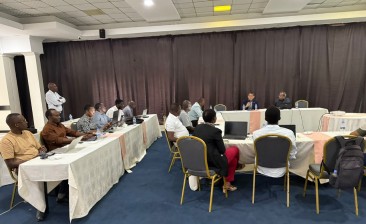
Kick-off meeting on M&E in Rwanda
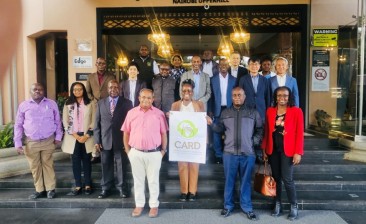
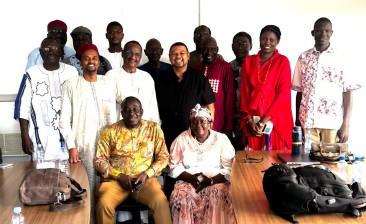
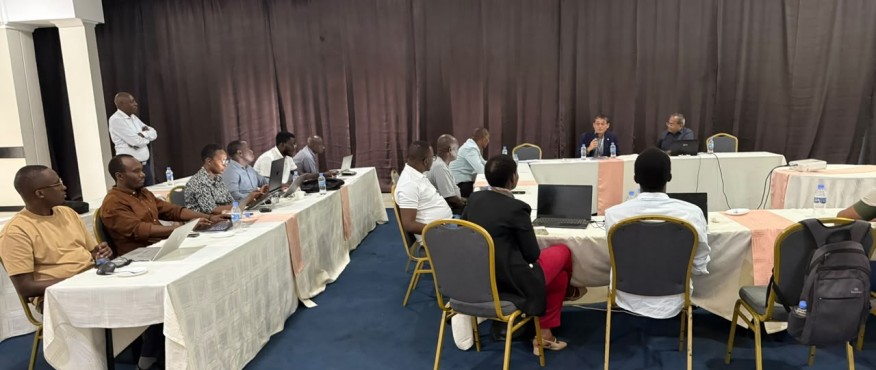
The workshop was organized at La Palisse Hotel in Nyamata during 11-13 August 2026. About 13 NRDS-TF members and resource persons from JICA and CARD participated in the discussions during various sessions.
Key objectives of the workshop are to (i) initiate the collection of data under the various M&E indicators that track progress made in overall development and R.I.C.E components, and (ii) accelerate resource mobilization for the rice value chain development in Rwanda.
Key outputs from the meeting
The NRDS-TF members reviewed the M&E indicators, methodologies and challenges that they faced during last year’s (2025-26) exercise. Through discussions, the NRDS TF agreed that except for data on rice imports, the M&E exercise for this year shall adopt the previous year’s protocols and sources. The data on rice imports appear to have multiple repositories in Rwanda, such as Rwanda Revenue Authority (RRA), National Bank of Rwanda (BNR), National Institute of Statistics of Rwanda (NISR) and Ministry of Trade and Industry (MINICOM), and external sources such as FAO and USAID. Unfortunately, the figures available with these institutions differ and are not consistent over the past several years. The NRDS-TF members inferred that the inconsistencies could largely emerge from the inclusion of re-imports and re-exports under the imports and exports category, and exclusion of informal trade. The members agreed that going forward, they will adopt importation data available with NISR.
The NRDS-TF members informed that there was no new introduction of projects in rice sector in Rwanda during 2025. However, they expressed confidence that at least 2 new projects (from AfDB and Rikolto International) are in the pipeline. JICA-Rwanda office is also in the stage of planning two new interventions for rice sector. A JICA-sponsored rice breeder might be deployed to the Rwanda Agriculture Board (RAB) for developing new rice varieties from March 2027. In addition, JICA is consulting with MINAGRI to submit a new project concept note based on postharvest management of cereal grains with special emphasis on rice. The NRDS-TF members also informed that WFP is engaged in discussions with MINAGRI on developing food safety standards for rice grains that are supplied to School Feeding Programs in Rwanda.
The NRDS-TF members mutually assigned responsibilities to key members to follow up with relevant stakeholders and the Ministry to follow up on the progress and explore mobilization of new resources for rice sector development in Rwanda. Despite several possibilities for mobilizing resources, the NRDS-TF members identified several gaps and the extent of severity using colour codes on the rice subsector intervention element matrix (SIEM).
CARD Secretariat, in collaboration with AGRA, is planning to mobilize resources for two of the most important binding constraints. In this regard, the NRDS-TF members identified the following as the two most important binding constraints for rice sector development: –
- Quality of seed supplied to seed producers & farmers – Equipment for quality inspection/labelling & sealing
- Postharvest grain quality management & marketability enhancement:
- Drying through alternative technologies/methodologies (than traditional drying yard) – to reduce time involved and increase scale of drying in marshlands
- Enforcement of grain standards & safety regulations (FDA)
In response to suggestions made by the stakeholders during the 2nd Annual Rice Sector Review Meeting (ARSRM) and emerging issues identified by the NRDS-TF during the M&E data collection & analyses, the NRDS-TF members updated the existing concept notes by including the following components: –
- Low-emission rice production under CN # 5 by incorporating components on: –
- adaptive research, extension (capacity building),
- cultivation & crop management techniques and
- policies (incl. carbon markets)
- Mechanization under CN # 7 by incorporating components on: –
- promotion of usage of harvesting and
- postharvest machineries by smallholder farmers
- Seed quality and traceability under CN # 8 by incorporating components on
- upgrading/procuring equipment for seed testing, labelling & sealing
- digitalization of seed production (in the context of traceability of seeds and grains)
- grain safety and quality (grades/standards) enforcement and safety regulations
Way forward
The NRDS task force agreed to finalize the updated concept notes and complete the data collection for all the M&E indicators by 30th September, and organize validation of the data on 8th October via online. Four of the NRDS taskforce members have agreed to follow up on potential project formulation by AfDB, Rikolto International, WFP and JICA. The Focal point of the NRDS task force has agreed to ensure coordination between the DPs and MINAGRI and engage WFP for co-sponsorship of the 3rd ARSRM event by January 2027.