Madagascar, September 2026
When Rice Tells the Story of a Nation
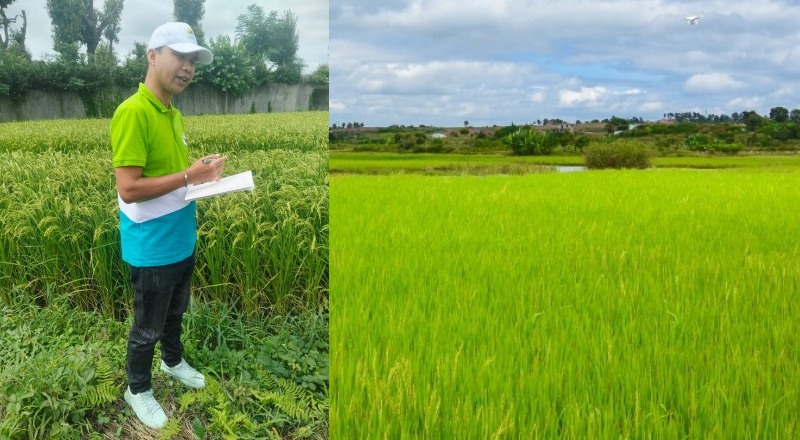
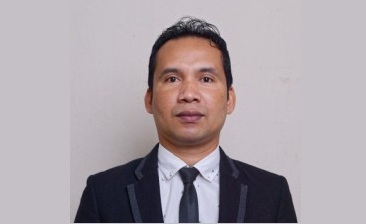
Interview with Mr Lovaniaina RAKOTONDRANAIVO
NRDS Focal Point in Madagascar – Director General of Agriculture at the Ministry of Agriculture and Food Sovereignty (MiASA)
An agronomist whose career is closely intertwined with rice
In Madagascar, it is difficult to be an agronomist without crossing paths with rice. For Mr. Lovaniaina RAKOTONDRANAIVO, this connection dates back to his student years. In 2005, his final-year dissertation focused on rice cultivation in the Antananarivo plain, with particular attention to irrigation and water management.
After an initial experience in the private sector, he joined the Ministry of Agriculture in 2015. He went on to head the Official Service for Seed and Planting Material Control (SOC) for six years, before becoming Director of Support for Crop Production (DAPV), and, in April 2026, Director General of Agriculture (DGA). He has also served as Madagascar’s NRDS Focal Point since June 2024, reflecting a professional career closely linked to the development of Madagascar’s rice sector.
Beyond his work as an agronomist, Mr. Rakotondranaivo is also an artist. Passionate about music and sound, he is also a singer-songwriter, perhaps another way of cultivating harmony!
A centuries-old story of rice
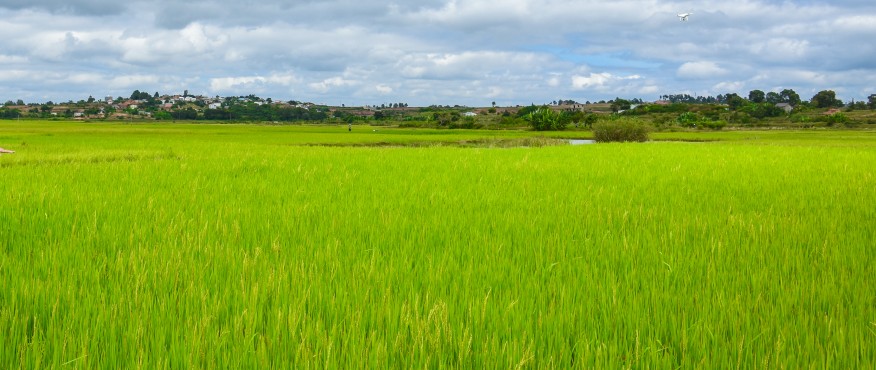
Rice has been part of Madagascar’s history since the island’s early settlement. Coming from Southeast Asia, the ancestors of the Malagasy people brought with them far more than their traditions: they also passed down their knowledge of rice cultivation. Over the generations, rice farming became deeply rooted in Madagascar’s landscapes, from the terraced rice fields of the highlands to the country’s various production areas. Gradually, rice became much more than a food: it became a heritage, a tradition, and a true marker of Malagasy identity. This is why rice consumption in Madagascar is among the highest in the world, at 118 kg per person per year.
“Vary maina”, “vary sosoa” and “laoka”: Malagasy rice throughout the day
If there is one product that tells the story of Madagascar, it is rice. As the staple food of the Malagasy people, it may be eaten three times a day: in the morning, at midday and in the evening. Rice farming is also practiced by a very large share of the population.
Rice accompanies the different moments of daily life in Madagascar. “Vary maina”, a relatively dry style of cooked rice, is generally eaten at lunchtime while “Vary sosoa”, prepared with more water and with a softer texture, is more commonly served in the morning and sometimes in the evening.
It is also difficult to imagine rice without its “laoka”, the accompanying dish, which can take many forms depending on the region and family traditions. Beyond everyday meals, rice is an important part of ceremonies and major events where food is shared.
Rice also appears in many other forms in Malagasy cuisine. It is used to prepare several much-loved specialties, such as “mofo gasy”, “mokary” and “koba”, sweet treats made from rice flour. From breakfast and snacks to celebrations, these foods reflect the richness and creativity of Malagasy cuisine and the unique place rice holds in everyday life.
From North to South, rice is grown throughout the country
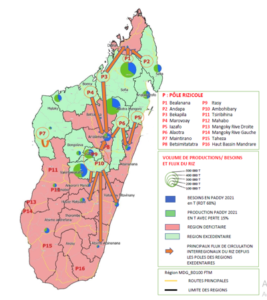
One distinctive feature of Madagascar is that rice is grown in all 24 regions of the country, although conditions and production levels vary considerably. Several regions have been identified as high-potential rice-growing hubs, including Alaotra-Mangoro, Boeny, Sofia, Menabe, Melaky, Analamanga, Itasy, Vakinankaratra, SAVA, Analanjirofo, Atsimo-Andrefana and Anosy.
Rice production systems are also diverse, ranging from irrigated and flood-prone lowland rice cultivation to rainfed rice grown in upland and watershed areas”. However, a significant share of rice-growing areas still faces inadequate water control, while traditional farming practices remain widespread.
Better connecting production areas with consumption areas
Another major challenge concerns the distribution of rice within the country. While some regions may record production surpluses, others, particularly in the South, continue to face severe food insecurity. The isolation of several production basins and the condition of road infrastructure make it difficult to transport rice to the areas that need it most and increase the number of intermediaries. Improving roads and marketing channels is therefore an essential lever for better connecting production areas to markets, facilitating supply flows and strengthening food security nationwide.
Producing more and better: the major challenge
Madagascar has a long tradition of rice cultivation and significant production potential. Yet the country still relies on imports to meet its domestic demand. One of the main challenges is therefore to sustainably increase productivity, particularly through agricultural intensification, improved yields and better water management.
Mechanization is another important lever for easing producers’ workload and expanding cultivated areas. Another unavoidable challenge for the Big Island is strengthening rice farming’s resilience to climate hazards, particularly cyclones, which can cause substantial crop damage.
When innovation meets tradition
Change is already under way. New rice-growing techniques are gradually being disseminated among producers, particularly through PAPRiz and the System of Rice Intensification (SRI). The use of agricultural machinery, both manual and motorized, is also expanding, while the development and productive use of rice-growing basins are among the priorities.
Water remains a central issue. As the Focal Point emphasizes, the challenge lies not only in water availability, but also in the ability to manage and use available water more effectively. The construction and rehabilitation of dams, together with irrigation and water-management infrastructure, are therefore major areas of intervention.
From the rice field to the plate: creating more value
Producing more will not be enough: Malagasy rice must also be better valorized. Today, processing beyond milling remains limited, and a large share of production goes directly to consumption. According to the Focal Point, developing new rice-based products therefore represents a genuine opportunity to create additional value and to improve the nutritional dimension of consumption.
Another challenge lies between the rice field and the consumer. Some production areas remain difficult to access, increasing the number of intermediaries and complicating the transport of rice to markets. Improving infrastructure and marketing channels will therefore also be essential to ensure that progress made in the fields fully benefits both producers and consumers.
Towards rice self-sufficiency
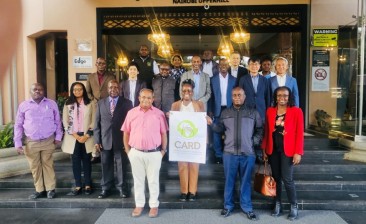
Through the implementation of NRDS 3, Madagascar is pursuing its ambition to move towards rice self-sufficiency and fully harness its rice-production potential. Since its launch in 2008, the country has benefited for nearly two decades from CARD’s support in strategic planning for the sector. CARD has supported Madagascar in developing its three successive generations of NRDS, by facilitating consultation among stakeholders, the definition of priorities and the mobilization of partners around the development of the rice sector.
Today, NRDS 3 continues this momentum, with a focus on production intensification, mechanization, the development of rice-growing basins, access to inputs and private-sector involvement.